
Blog
Rolex GMT-Master II 126710BLNR Buyer’s Guide: Bezel, Bracelet, Movement
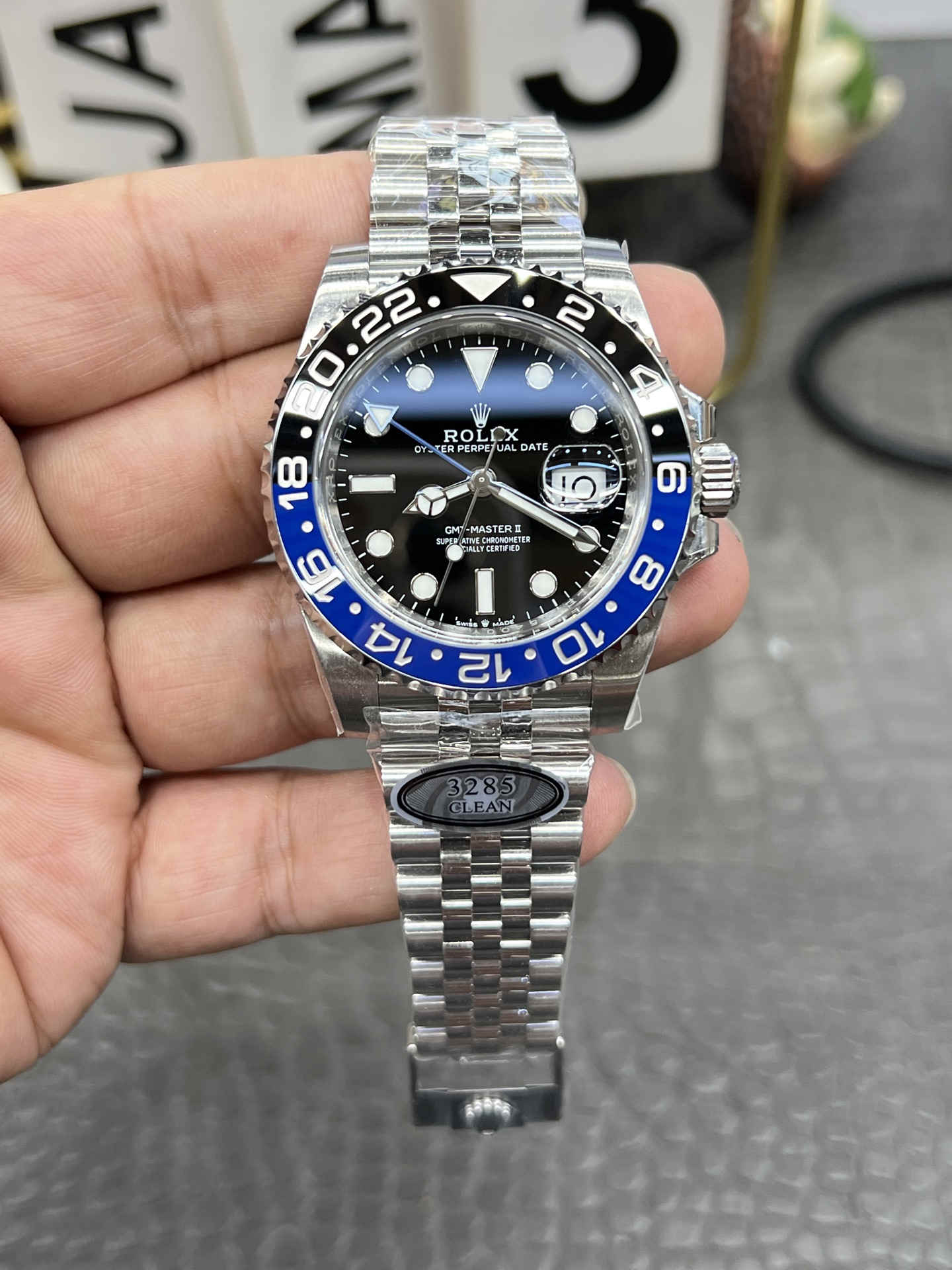
Few references get argued about as much as the GMT-Master II 126710BLNR. The blue-and-black ceramic bezel — BLNR, for bleu/noir — gave the GMT-Master II a look that is instantly readable from across a room, and the nickname that stuck, “Batman”, is now used by people who have never handled one. This guide covers the things that actually vary between examples, so you know what to look at when you compare two listings.
The reference in numbers
| Case size | 40 mm |
| Case material | Oystersteel (904L-family stainless steel) |
| Bezel | Bidirectional 24-hour, blue and black ceramic, platinum-group numeral fill |
| Calibre | 3285 automatic, integrated GMT with jumping local hour hand |
| Power reserve | ~70 hours |
| Water resistance | 100 m |
| Bracelet options | Oyster (three-link) or Jubilee (five-link) |
| Crystal | Sapphire with cyclops date lens at 3 o’clock |
Bezel: the part that decides everything
On a two-tone ceramic bezel the hard part is not the colour, it is the seam. The insert is moulded in two halves and joined, and a good example shows a razor-sharp boundary with no blurred third colour creeping into the join. Under a lamp, run your eye along the transition at 12 o’clock and at 6 o’clock:
- The boundary should be a straight line with no gradient band.
- Blue should read as a deep, slightly matte navy under natural light, not a bright flat blue.
- The 24-hour numerals are filled rather than printed; they should sit flush in the ceramic with crisp edges, not pooled or proud.
- The bezel should turn in 24 crisp steps with a firm hold and no wobble between positions.
On a bright blue that is slightly wrong, the whole watch reads wrong, regardless of how good the case finishing is. This is the single highest-value thing to inspect.
Movement: what “integrated GMT” means for you
The 3285 is an integrated GMT calibre: the 24-hour function is part of the movement architecture, not a module bolted onto a standard three-hand calibre. The practical difference shows up when you set the watch:
- Pulling the crown to the first position and turning it should move the local hour hand in one-hour jumps, with the minute hand and the GMT hand staying put and the seconds still running.
- The GMT hand should keep tracking the second time zone you set the day before.
- Resetting the date should follow the hour hand naturally as it passes midnight.
If the crown moves the GMT hand instead of the local hour hand, you are not looking at an integrated GMT mechanism, whatever the caseback says. That single test tells you more than any documentation.
The 3285 also carries a long mainspring, so expect roughly 70 hours from a full wind. In practice that means you can take the watch off on Friday evening and it will still be running on Monday.
Oyster or Jubilee?
Both have been offered on this reference, and the choice is purely about how you want the watch to read:
| Oyster | Jubilee | |
|---|---|---|
| Look | Sporty, tool-like, familiar | Dressier, more jewellery-like |
| Link count | Three-piece links | Five-piece links with polished centre sections |
| Feel | Firmer, more rigid | Softer, wraps the wrist more closely |
| Wear | Hides scratches better | Polished centres show marks sooner |
Buyers who came to the GMT from a Submariner tend to prefer the Oyster. Buyers who want one watch for both a shirt and a t-shirt lean Jubilee. If you are unsure, choose the bracelet that matches the watch you already own least — that is usually the one you will actually keep.
What to check on a specific example
- Date centring in the cyclops window, and the black hole effect of the anti-reflective coating under the lens.
- Hands alignment — at midnight the date should change cleanly and the hands should stack without a visible gap at the tips.
- Lume on the hour markers, the hands and the bezel triangle; charge it under a lamp and check for an even glow.
- Bezel insert fit — it should sit slightly proud of the bezel ring with an even gap all the way round, not tilted or pinched at one point.
- Bracelet end links — they should sit flush to the case with no visible daylight and no rattle when you flex the watch gently.
- Timegrapher reading before shipping, with rate, amplitude and beat error all reported.
The GMT-Master II is a watch that rewards a careful eye more than a careful spec sheet, because the differences between two good examples live almost entirely in the bezel and the dial. Once you have that dialled in, the rest of the watch is straightforward.
You can see the current line-up, including Oyster and Jubilee variants, in our GMT-Master II collection. If you are weighing this against a Submariner, our Submariner collection covers the other side of that comparison.